"MISTAKES"--
NO SERENDIPITY IN SILICON
Dennis B. Kottler, MD
Westlake Village, CA
Appointments: 818-991-8376
Email: doc@psychiatrix.com
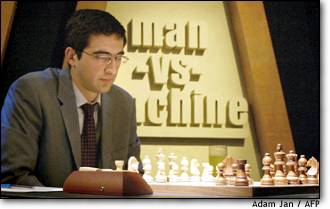
The “Brains in Bahrain” chess match, pictured above, pitted world champion Vladimir Kramnik against Deep Fritz, a computer program. The match ended Saturday, October 14, 2002 with a 4-4 draw.
Why is this important?
Vladimir Kramnik played a brilliant match full of chess cunning and drama. In one particularly unfortunate game, Kramnik went for the (computer's) throat, sacrificing a piece to set up a scathing assault. This led to unforeseen trouble and a win for the computer. Kramnik called his decision to attack “a very human thing. You also want to enjoy chess.”
The
computer, lacking emotion and not programmed to gamble, made no such
"mistakes." It hammered away at the human opponent with
relentless silicon logic.
The "BUGGY" BRAIN
Perhaps the human brain is DESIGNED to take chances and to make "mistakes." These "mistakes" serve a purpose, just as random gene mutations produce a benefit for the species. Thus, from the serendipity of mistakes springs beauty and creativity...and sometimes revolutionary new ideas.1 There is no serendipity in silicon.
Not Just "BUGGY"
Back to Kramnik. His
"buggy" mind is further Shanghaied by emotion, by the desire for
enjoyment….boredom is his worst nightmare..
A FINAL THOUGHT
What is PRACTICE, PRACTICE, PRACTICE all about. Why do athletes have to PRACTICE over and over before they get a "move" right, whereas a cat, without any PRACTICE, can leap from a height of many yards and land perfectly every time (usually). Why does the pianist have to PRACTICE a piece thousands of times to get it "right." What a waste of time.
Felines are probably not "smarter" than humans. Humans just make more mistakes...since the brain is BUGGY by design. The downside of this bugginess is PRACTICE. When we strive for consistent results, e.g. making free throws or bowling strikes, we have to overcome the inherent bugginess by constant repetition until we have effectively "re-programmed" our synapses.2 Endless hours of PRACTICE may be a small price to pay for the huge serendipitous rewards of being BUGGY.
1 Rubber, plastics, telephones, and the discovery of America are all examples of "mistakes."
2 In addition to the buggy brain problem, athletes also have to purify the brain of all intrusive, conscious thoughts which sabotage success...less a problem for other animals.
Appointments: 818-991-8376
Email: doc@psychiatrix.com